
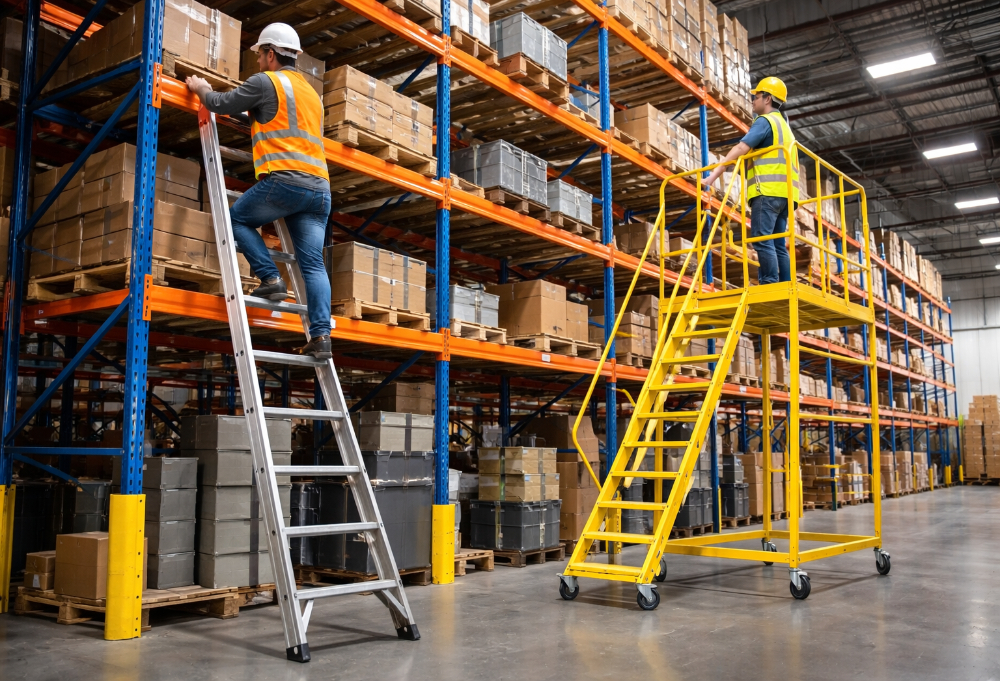
Choosing the Right Ladder for Elevated Platforms and Storage Racks
March 6, 2026 1:03 pm Leave your thoughtsWhen it comes to working safely and efficiently at height, few decisions carry more weight than selecting the right equipment. Whether you are managing a warehouse, outfitting a manufacturing floor, or organizing a multi-level storage facility, ladders for elevated platforms are a critical part of daily operations. The wrong choice can lead to accidents, inefficiencies, and costly liability. The right choice, on the other hand, supports productivity, meets safety codes, and keeps your team confident on the job. This guide walks through the key factors that should shape every platform ladder selection decision.
The Different Types of Ladders for Elevated Platforms
Not every ladder is built for the same purpose, and that distinction matters enormously when you are dealing with elevated platforms and storage racks. The most common types used in industrial and commercial settings include rolling ladders, fixed access ladders, alternating tread ladders, and crossover ladders.
Rolling ladders are among the most popular choices for warehouses and distribution centers. They move freely along a rail system or can be repositioned manually, giving workers access to varying rack heights without the need to carry heavy equipment across the floor. Fixed access ladders, by contrast, are permanently mounted to a structure and are ideal for areas with consistent, repeated access needs such as mezzanines, equipment platforms, and rooftop access points.
Alternating tread ladders are engineered for tight spaces where a traditional staircase would not fit. They allow a steeper angle while still providing a secure, comfortable step for the user. Crossover ladders serve a more specific purpose: helping workers safely navigate over pipes, conveyor systems, or other floor-level obstructions. Understanding which type fits your environment is the first real step in any responsible platform ladder selection process.
Key Safety Standards and Compliance Requirements
Safety is not optional in any workspace, and the ladder industry is heavily regulated for good reason. In the United States, OSHA standards under 29 CFR 1910 and 1926 govern the design, use, and maintenance of ladders in general industry and construction environments. ANSI standards, particularly ANSI A14.3 for fixed ladders and ANSI A14.7 for rolling ladders, provide detailed specifications for load capacity, rail height, rung spacing, and surface treatment.
When selecting ladders for elevated platforms, you must verify that your equipment meets the applicable load ratings. Most industrial ladders are rated for either 250 or 300 pounds, though heavy-duty models can accommodate 375 pounds or more. This rating must account for the worker, their clothing, and any tools or materials they may be carrying.
Beyond load ratings, guardrail requirements are critical on any platform designed for workers to stand or work on. OSHA requires guardrails on platforms that are 48 inches or higher from the ground. Your platform ladder selection should include equipment that either integrates guardrails directly or is compatible with the guardrail systems already in place at your facility.
Matching Ladder Design to Your Storage Rack Configuration
Every storage rack system has its own footprint, height profile, and access requirements. A ladder that works perfectly in a pallet rack system may be entirely unsuitable for a vertical carousel or a cantilever rack setup. Before committing to a purchase, you need to assess the specific geometry of your storage environment.
Height is the most obvious variable. Ladders for elevated platforms must reach the highest working point comfortably, without requiring a worker to stand on the top two rungs, which is never safe practice. As a general rule, the platform height of a rolling ladder should be at least 24 inches below the worker’s reach to allow for safe and ergonomic operation.
Aisle width is another consideration that is often overlooked. Rolling ladders require clearance for movement, and in narrow pick aisles, this can create significant challenges. Some manufacturers offer specially designed narrow-aisle rolling ladders with a reduced footprint that allow access in aisles as tight as 24 to 30 inches. If your rack layout involves these configurations, your platform ladder selection must account for mobility constraints from the start.
Weight and portability matter too. In fast-moving warehouse operations, a ladder that is difficult to reposition quickly can slow down pick rates and frustrate workers. Lightweight aluminum designs are popular for this reason, though they must still meet all relevant load capacity requirements.
Surface, Tread, and Ergonomic Considerations
A ladder is only as good as its tread surface. Workers who spend hours climbing and descending ladders need surfaces that grip reliably in wet, oily, or dusty conditions. Perforated steel, serrated grating, and fiberglass grating are all common tread materials, each with distinct performance characteristics depending on the environment.
In food processing or pharmaceutical facilities, for example, open-grate treads that resist liquid accumulation are often preferred. In general warehouse settings, rubber-coated or anti-slip aluminum treads perform reliably and are easy to maintain. Fiberglass treads are especially valued in environments where chemical exposure is a concern because they resist corrosion without sacrificing grip.
Ergonomics should also factor into your platform ladder selection. Handrail height, rung diameter, and rung spacing all affect how comfortably and safely a worker can ascend and descend repeatedly throughout a shift. Handrails positioned between 30 and 37 inches above the tread level provide the most natural grip for most users. Rung diameters between 1 and 1.5 inches are generally considered the most comfortable for extended use.
Self-closing gates on ladder platforms are another ergonomic and safety feature worth prioritizing. They prevent workers from accidentally stepping off the platform edge and eliminate the risk of leaving an access point open in a busy aisle.
Evaluating Long-Term Costs and Maintenance Requirements
The purchase price of a ladder is only the beginning of its total cost. Facilities that purchase low-cost ladders and neglect ongoing maintenance often face higher long-term expenses through accelerated replacement cycles, safety incidents, and downtime.
Aluminum ladders are generally low-maintenance and resist corrosion well, making them a cost-effective choice for most indoor environments. Steel ladders offer greater strength and rigidity but require more attention to surface coatings to prevent rust, particularly in humid or wet environments. Galvanized or powder-coated finishes extend service life considerably.
Regular inspection schedules are non-negotiable. OSHA requires that ladders be inspected before each use and that damaged ladders be immediately removed from service. Facilities with many ladders benefit from a formal tagging and inspection program that tracks each unit, documents service history, and flags equipment due for replacement.
When budgeting for ladders for elevated platforms, factor in not just the initial cost but also the projected maintenance demands, expected service life, and the cost of compliance over time. A slightly higher upfront investment in a quality ladder often pays for itself within the first two to three years of heavy use.
Conclusion
Selecting the right ladder for elevated platforms and storage racks is a decision that touches safety, productivity, compliance, and long-term facility costs all at once. By understanding the types of ladders available, adhering to applicable safety standards, matching ladder design to your specific rack configuration, prioritizing surface and ergonomic quality, and planning for long-term maintenance, you can make a platform ladder selection that serves your team well for years to come. The goal is not simply to find a ladder that works today but to invest in equipment that keeps workers safe, operations efficient, and your facility compliant in every season of business.
Need a Steel Construction Company in Terre Haute, IN?
Benchmark Fabricated Steel is a premium service provider for all your metal and steel needs since 1971. We offer an array of services and products for commercial, business, and corporation work. Our fully trained team is available for project design, erect drawings, site construction, product procurement and delivery, engineering and consulting, and much more. Benchmark Fabricated Steel is fully accredited by the AISC and the Canadian welding association allowing for the highest quality product to be produced. Our business is also recognized by the Chamber of Commerce and is a fully certified fabricator. All of our products are manufactured by the highest quality of equipment, with an expert and knowledgeable staff. Contact us today to learn more about what we can do for you!
Categorised in: Products
This post was written by admin