
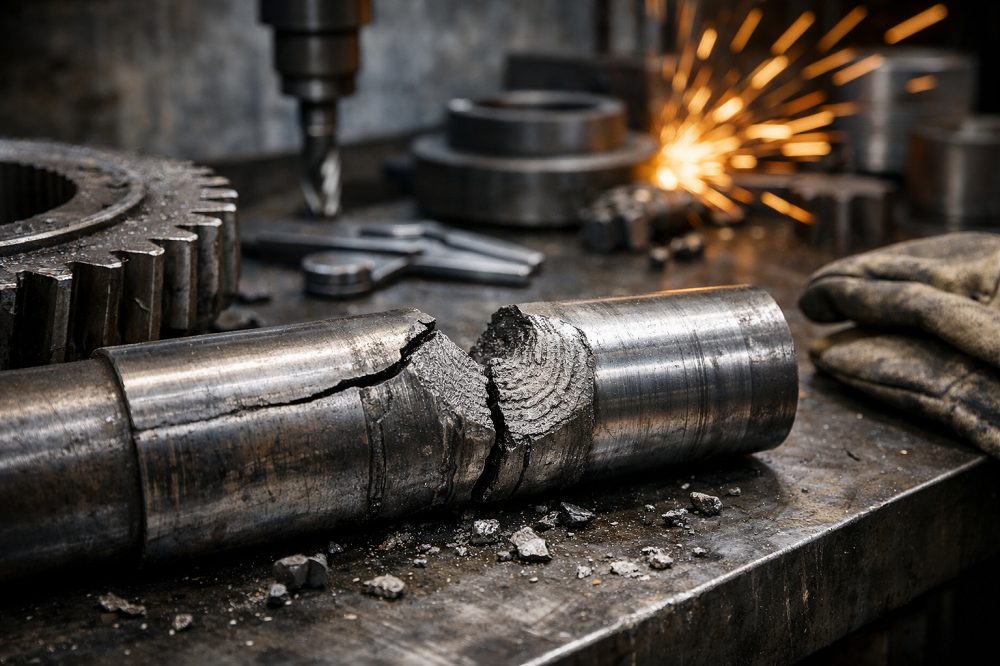
Fatigue Failure in Steel: Causes and Prevention in Fabrication
March 6, 2026 1:03 pm Leave your thoughtsSteel is one of the most trusted materials in construction, infrastructure, and protective applications. It forms the backbone of bridges, buildings, and security installations. Yet even the toughest steel components can fail over time, not from a single catastrophic load, but from the slow, invisible accumulation of stress cycles. This phenomenon is called fatigue failure, and it represents one of the most serious challenges in steel fabrication. Understanding how fatigue develops, why it matters, and how to prevent it is essential for engineers, fabricators, and anyone who relies on steel structures to perform reliably for the long term.
What Is Fatigue Failure and Why Does It Happen?
Fatigue failure occurs when a material fractures after being subjected to repeated cycles of stress, even when those stresses are well below the steel’s ultimate tensile strength. Unlike a sudden overload failure, fatigue is gradual and often gives no visible warning until a crack has already propagated to a critical size.
The process typically begins at a microscopic level. When steel is loaded and unloaded repeatedly, tiny dislocations form within the grain structure of the metal. These dislocations accumulate at stress concentration points: surface scratches, weld toes, notches, holes, and abrupt changes in cross-section. Over thousands or millions of cycles, these micro-level disturbances grow into small cracks. The cracks then propagate incrementally with each additional load cycle until the remaining cross-section can no longer carry the applied load, resulting in sudden fracture.
The number of cycles a steel component can endure before failure depends on the stress range applied, the material’s microstructure, surface condition, residual stresses from fabrication, and environmental factors such as corrosion. Higher stress amplitudes lead to fewer cycles before failure, while lower stress amplitudes can allow millions of cycles before fatigue damage becomes critical.
Common Causes of Fatigue in Fabricated Steel Components
Several factors in the fabrication process can significantly reduce a steel component’s fatigue life. Weld quality is among the most critical. Welds introduce sharp geometric discontinuities at the weld toe and root, and they leave behind residual tensile stresses from the rapid heating and cooling of the welding process. These residual stresses add to applied service stresses and accelerate crack initiation.
Poor surface finish also plays a major role. Machining marks, grinding scratches, and tool marks act as stress risers, giving fatigue cracks an easy starting point. Even small surface defects that would otherwise seem cosmetic can reduce fatigue life by a significant margin.
Improper heat treatment is another contributor. Steel that has not been properly normalized, annealed, or stress-relieved after fabrication may retain internal stresses that predispose it to early fatigue cracking. Similarly, cold forming operations that introduce cold work without subsequent stress relief can leave unfavorable residual stress distributions in the part.
Corrosion interacts with fatigue in a particularly damaging way. When steel is exposed to moisture, chemicals, or road salts, corrosion pits form on the surface. Each pit acts as a stress concentration, and the combination of cyclic loading with a corrosive environment, known as corrosion fatigue, dramatically accelerates crack growth compared to either factor acting alone.
The Role of Steel Bollards in High-Cycle Loading Environments
One area where fatigue considerations are especially relevant is the design and fabrication of impact-resistant bollards. These steel posts are installed at building entrances, parking areas, pedestrian zones, and roadway perimeters to protect people and property from vehicle incursions. Because they are exposed to repeated impacts from vehicles, shopping carts, and service equipment, they experience genuine cyclic loading throughout their service lives.
This is a key part of why use steel bollards rather than alternative materials in many applications. Steel offers a combination of high yield strength, toughness, and ductility that allows properly fabricated bollards to absorb and distribute impact energy without brittle fracture. The material’s fatigue performance, when fabrication is done correctly, allows impact-resistant bollards to withstand repeated strikes over many years of service.
However, if fatigue considerations are ignored during fabrication, even a high-strength steel bollard can develop cracks at the base weld or at stress-riser locations near mounting hardware. This is why weld quality, surface preparation, and post-fabrication treatment are non-negotiable for bollard manufacturers aiming to produce long-service, reliable products.
Prevention Strategies in Steel Fabrication
Preventing fatigue failure requires attention at every stage of the fabrication process, from design to final inspection. The following approaches represent industry best practice.
Geometric design should minimize stress concentrations wherever possible. Abrupt transitions in cross-section should be replaced with smooth fillets and tapers. Holes and cutouts should be located away from regions of peak stress. Where notches are unavoidable, their geometry should be optimized to reduce the local stress amplification factor.
Weld quality control is paramount. Full-penetration welds are preferred over partial-penetration welds in fatigue-critical joints. Weld toes should be dressed by grinding or shot peening to improve the local geometry and introduce compressive residual stresses. Post-weld heat treatment can reduce tensile residual stresses left by welding, and weld inspection using ultrasonic testing or radiography should be standard practice for critical components.
Surface treatments such as shot peening, which bombards the surface with small spherical media, induce a layer of compressive residual stress at the surface. Because fatigue cracks initiate and grow fastest in regions of tensile stress, this compressive surface layer provides a meaningful improvement in fatigue resistance. Surface coatings and corrosion protection systems further extend service life by preventing the formation of corrosion pits.
Material selection also matters. Higher-strength steels do not always offer proportionally better fatigue performance, particularly in welded structures, because the fatigue life of a welded joint is often governed by the geometry of the weld rather than the base material strength. Selecting a steel grade with good notch toughness and a fine grain structure provides a better foundation for fatigue-resistant fabrication.
Inspection, Monitoring, and Long-Term Management
Preventing fatigue failure does not end when a steel component leaves the fabrication shop. Ongoing inspection and monitoring are critical, especially for structures and products that operate in demanding environments.
Non-destructive testing methods, including magnetic particle inspection, dye penetrant testing, and phased array ultrasonic testing, allow inspectors to detect surface and subsurface cracks before they reach a critical size. Establishing an inspection schedule based on the expected stress cycles and service conditions allows operators to catch fatigue damage early and perform maintenance repairs, such as re-welding, grinding, or component replacement, before failure occurs.
For steel structures that experience well-defined loading, such as bridges or crane runways, fatigue life can be estimated using S-N curves (stress versus number of cycles to failure) in combination with cycle counting methods like rainflow counting. This approach gives engineers a rational basis for scheduling inspections and predicting remaining service life.
Conclusion
Fatigue failure is a silent threat in steel fabrication, developing gradually through cyclic loading until a component fails with little warning. By understanding the mechanisms behind fatigue, identifying common fabrication-related risk factors, and applying proven prevention strategies, engineers and fabricators can produce steel components that serve reliably for their intended lifespans. For products like impact-resistant bollards, where repeated loading is a given, these principles are not optional refinements but fundamental requirements. The question of why use steel bollards often comes back to their material and fabrication quality, and fatigue-resistant design is at the heart of what separates a reliable installation from one that fails prematurely. Investing in proper design, fabrication practice, and ongoing inspection is the most cost-effective way to ensure that steel performs as expected, cycle after cycle, year after year.
Need a Steel Construction Company in Terre Haute, IN?
Benchmark Fabricated Steel is a premium service provider for all your metal and steel needs since 1971. We offer an array of services and products for commercial, business, and corporation work. Our fully trained team is available for project design, erect drawings, site construction, product procurement and delivery, engineering and consulting, and much more. Benchmark Fabricated Steel is fully accredited by the AISC and the Canadian welding association allowing for the highest quality product to be produced. Our business is also recognized by the Chamber of Commerce and is a fully certified fabricator. All of our products are manufactured by the highest quality of equipment, with an expert and knowledgeable staff. Contact us today to learn more about what we can do for you!
Categorised in: Steel Fabrication
This post was written by admin